
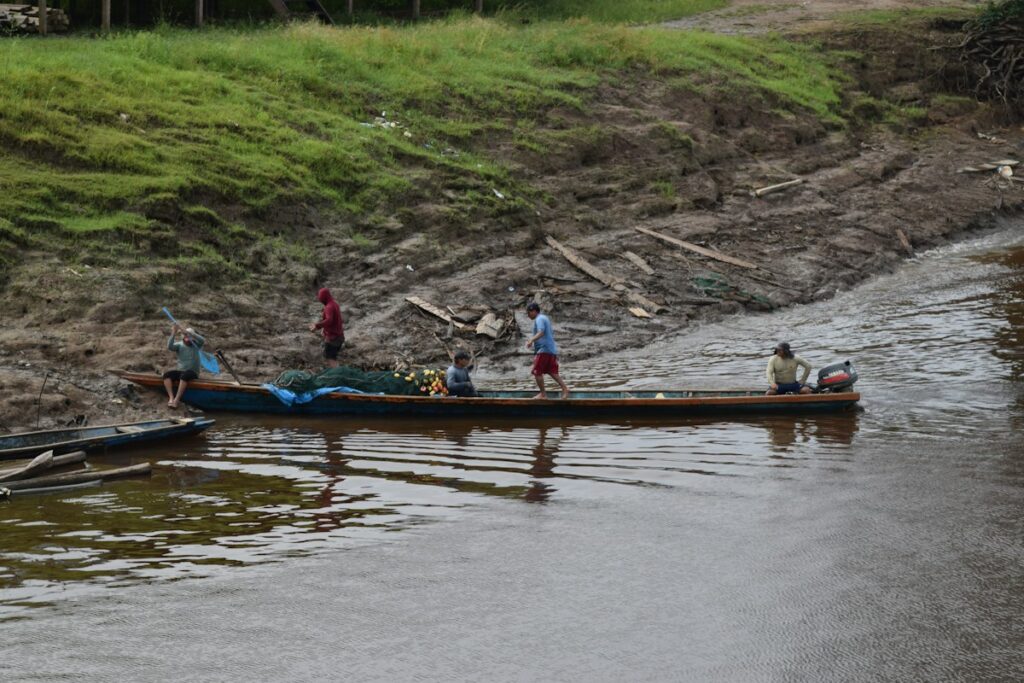
One of the most inspiring recent examples on basic income comes from communities organizing basic income for themselves, with Indigenous women’s organizations in the lead.
A World-First Pilot Designed From the Ground Up
Researchers from the University of Bath’s Universal Basic Income Research Group have released their analysis of the first basic income pilot ever run with Amazonian Indigenous people. Over two years, 211 people in three communities in Peru’s Asháninka region received unconditional cash transfers of 1,032 soles, roughly the equivalent of two pounds a day, to spend exactly as they chose.
What makes this project stand out is who designed it. The climate charity Cool Earth co-developed the pilot with two all-female Indigenous-led organizations: the National Organisation of Indigenous Andean and Amazonian Women of Peru (Onamiap) and the Organisation for Indigenous Women of the Central Selva of Peru (Omiaasec). Instead of a top-down program, the communities themselves were treated as the driving force. AidKit, an international aid and technology organization, worked out the practical delivery of cash into communities deep in the forest.
Cash Plus: Money Backed by Community Training
The pilot used a so-called Cash Plus model. Alongside the unconditional payments, communities organized their own training program covering financial education, Indigenous rights and governance, environmental conservation and climate change. The “Plus” element is deliberately community-led: it helps communities organize rather than telling them what to do.
Real Results for People
The Bath analysis found significant improvements across income generation, livelihoods, community cohesion, education, food security and nutrition. Sofia Vargas, Cool Earth’s Peru country manager, said the pilot shows the opposite of the old dependency critique: “By alleviating the pressure of immediate survival, regular income enabled rainforest communities to invest in long-term planning and productive assets.”
Families redirected time and resources into smallholder agriculture, invested in schooling for their children, bought household technology such as solar panels and Wi-Fi, and built up savings. That resilience matters in a region where climate change is already bringing more extreme weather, flooding and wildfires.
Real Results for the Rainforest
The pilot also strengthened environmental stewardship. With less pressure to migrate for work or exploit land, communities could keep investing in their own territory. Dr. Neil Howard, who leads UBI Bath, noted that the project “brings a multitude of benefits both to their communities and their environment”, a sharp contrast with the colonial history of conservation policy. It is a living example of how the fight against poverty and the fight for a liveable planet are one and the same struggle.
Cool Earth will now adopt the pilot as part of its ongoing work and enter a project design phase to bring basic income to new communities in Peru’s central Amazon, adding to the evidence base for basic income as a tool for both people and forests.
Why This Matters
This pilot answers a question the big government programs often leave open: what happens when communities themselves hold the pen? In the Asháninka region, the answer is stronger community life, better land use, dignity for historically marginalized people, and a forest that keeps standing. Onamiap vice president Elida de la Cruz summed it up: the communities have shown “our sisters have the capacity to carry out these projects on the ground.”
Source: Phys.org / University of Bath Source: Cool Earth Source: Unsplash image by Anthony Bringas (Unsplash License)